Finding
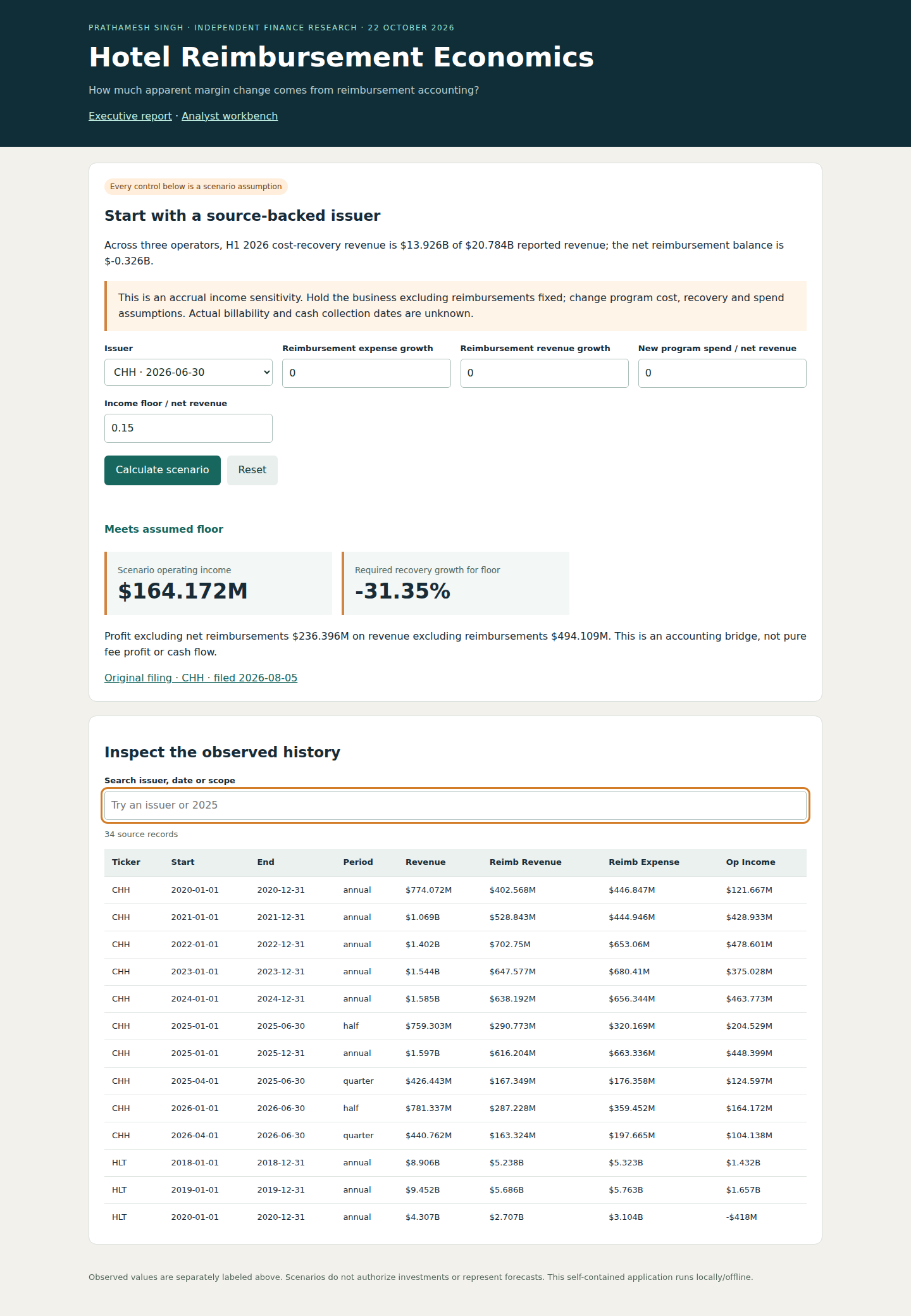
Across the selected operators in H1 2026, reported revenue totals $20.784 billion, including $13.926 billion in reimbursements. The net reimbursement balance is −$326 million. Excluding reimbursement revenue and net balances changes the margin ordering of two issuers, without isolating pure fee profitability.
Why it matters
Reconcile both income and revenue before comparing margins or approving program spending. Recoverability terms and a forward budget are needed to assess the cash and operating consequences.
Who could use this
Hotel-management/franchising FP&A and program-budget committees comparing operating performance.
Data and scope
34 issuer-period observations, including 22 annual periods, from 12 original SEC filings for Marriott, Hilton and Choice Hotels. Exact original-source figures and matched periods are retained.
How the analysis works
Reported-income identities and matched year-over-year bridges isolate reimbursement revenue and costs. A 216-case scenario grid tests incremental program spending against explicit income-floor assumptions.
Limits of the evidence
The net balance is an accrual subtotal, not a current cash deficit. Normalization does not isolate pure fee profit or remove all mix differences. Budget scenarios hold the other business fixed and are not earnings forecasts.