Finding
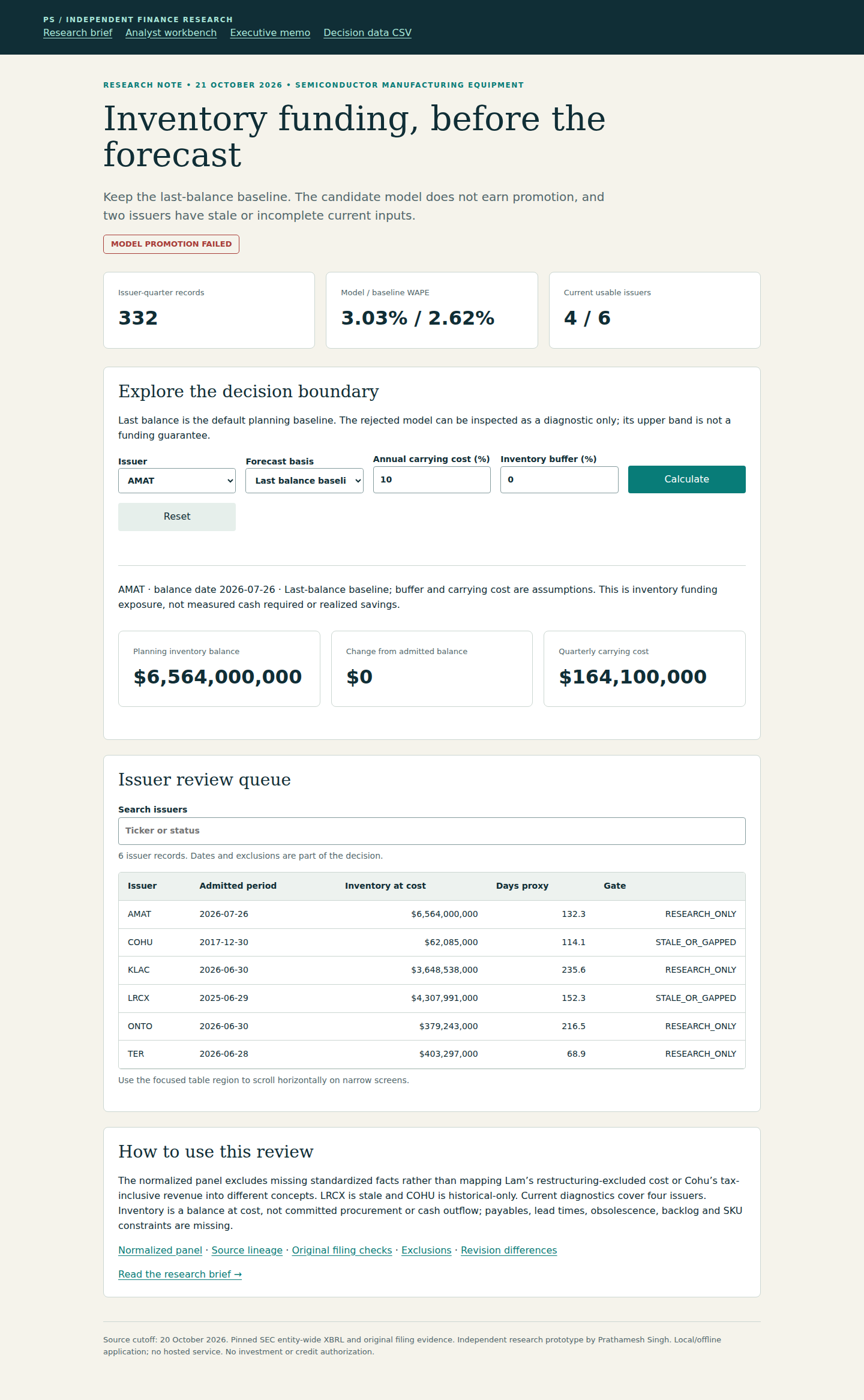
Across 47 later outcomes, candidate WAPE is 3.025%, versus 2.624% for the last balance. The nominal 90% bands cover 86.11% of 36 eligible outcomes. The candidate is not approved for use. Only four issuers have consistently defined current inputs for the planning screen.
Why it matters
Keep the baseline and repair source-definition gaps before testing a new model. Procurement planning also requires inventory aging, purchase commitments and service constraints.
Who could use this
Procurement and treasury analysts deciding which inventory balance forecast can support further planning.
Data and scope
332 coherent SEC company-quarters and 1,160 retained source figures, with 47 later test outcomes across five semiconductor-equipment issuers.
How the analysis works
Filing-availability-aware rolling ridge estimates use separate selection, calibration and test windows. Last-balance and seasonal baselines, issuer-cluster uncertainty and source-definition exclusions check model and data risk.
Limits of the evidence
Only four issuers have coherent current inputs. Five dependent sector histories limit uncertainty assessment. Inventory balance is not a procurement cash forecast, and assumed carry-cost examples are not savings.